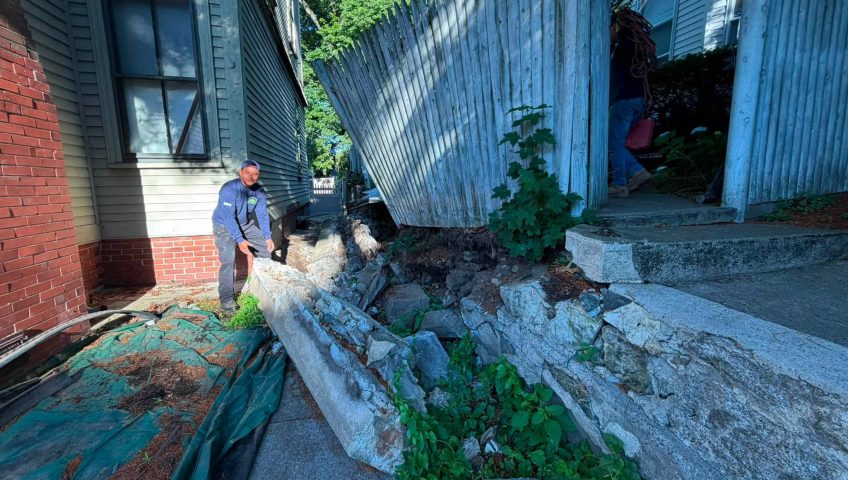
A failing stone retaining wall can quickly become more than just an eyesore—it can create serious safety hazards, damage nearby structures, and lead to expensive repairs if left unaddressed. The image above shows a significant retaining wall collapse beside a residential property, where displaced stone, soil movement, and structural failure have compromised the area between neighboring homes. Understanding why retaining walls fail can help homeowners recognize problems early and know when it’s time to call a professional for Retaining Wall Installation, Masonry Services, or Excavation Services.
Signs Your Stone Retaining Wall Is Failing
Retaining walls are designed to resist the pressure of soil while protecting nearby structures and landscapes. When they begin to fail, several warning signs often appear before a complete collapse occurs.
Some of the most common indicators include walls that lean outward, cracked or separated stone sections, bulging surfaces, loose capstones, and erosion around the base. Homeowners may also notice gaps forming behind the wall or water collecting where proper drainage has failed.
In severe cases, such as the wall shown here, entire sections can shift or collapse, exposing soil and creating unstable ground conditions. Once this level of movement occurs, temporary fixes are rarely enough to restore structural integrity.
What Causes a Stone Retaining Wall to Collapse?
Retaining wall failures typically result from one or more underlying structural problems rather than a single isolated issue.
Poor drainage is among the leading causes. Water trapped behind a wall creates hydrostatic pressure that increases over time until the wall can no longer withstand the load. Without proper drainage systems, even well-built walls can eventually fail.
Age also plays a significant role. Older stone retaining walls may have deteriorated mortar joints, weathered materials, or foundations that have shifted after decades of freeze-thaw cycles.
Inadequate footing preparation, improper construction techniques, overloaded soil conditions, tree root intrusion, and erosion beneath the wall can all contribute to structural instability.
Professional Excavation Services are often necessary to expose the foundation and determine whether the existing wall can be rebuilt or requires complete replacement.
Why Professional Retaining Wall Repair Matters
A collapsed retaining wall affects much more than the appearance of your property. It can threaten nearby walkways, foundations, fences, utilities, and neighboring structures.
Professional contractors begin by identifying the underlying cause of failure rather than simply replacing displaced stones. A proper repair often includes removing unstable materials, improving drainage, rebuilding the foundation, and reconstructing the wall using modern engineering practices.
Depending on site conditions, contractors may recommend natural stone reconstruction, reinforced concrete block systems, or engineered retaining wall solutions designed for the specific soil conditions.
Experienced Retaining Wall Installation professionals ensure proper grading, drainage pipe placement, compacted backfill, and structural reinforcement to improve long-term performance.
Attempting to rebuild a collapsed retaining wall without addressing the underlying issues can result in repeated failures and significantly higher repair costs in the future.
Preventing Future Retaining Wall Problems
While no retaining wall lasts forever, routine inspections and preventive maintenance can greatly extend its lifespan.
Keep drainage outlets clear, monitor for new cracks or movement, and remove vegetation that may introduce root pressure against the wall. After periods of heavy rainfall, inspect the wall for soil erosion, standing water, or newly displaced stones.
If small issues are addressed early, repairs are often far less extensive than rebuilding an entire wall after collapse.
Property owners should also avoid placing excessive weight near the top of retaining walls, including heavy landscaping features, vehicles, or storage materials that increase soil pressure beyond the wall’s original design capacity.
When structural movement becomes noticeable, scheduling an evaluation with professionals experienced in Masonry Services allows problems to be identified before they become emergency situations.
A properly engineered retaining wall not only protects your property but also improves safety, supports surrounding landscapes, and preserves long-term property value.
FAQ
What causes a stone retaining wall to collapse?
The most common causes include poor drainage, excessive water pressure, foundation settlement, aging materials, improper construction, soil erosion, and tree root intrusion.
Can a collapsed retaining wall be repaired?
Yes. Depending on the extent of the damage, contractors may rebuild portions of the wall or recommend a complete replacement. A professional inspection determines the safest and most cost-effective solution.
How do I know if my retaining wall needs replacement?
If your wall is leaning, bulging, separating, collapsing, or showing significant structural movement, it should be inspected promptly. Early repairs may prevent complete failure, but severe damage often requires reconstruction to ensure long-term stability.
